Saturday, April 7, 2012

Meta-Trader - New Leaders of Tech

Welcome back Meta-Traders.

Everything goes in cycles and nowhere more so than in the world of trading and investing.  Many great tech companies are started up by their founders and have a period of success.  But eventually, the leaders grow old, retire, or cash out early on their stock and go on to do something else with their millions.  Other times, the company just falls out of a competitive position

Once that happens, the company faces a moment of crisis.  The founders have moved on and the company faces a challenge to either survive or die.  And its the natural tendency of every business to either expand or contract.   The process is very well described in a book called The E-Myth Revisited by Michael Gerber which is an excellent beach read when you get the chance.

Two such companies that face that moment of crisis now are Blackberry Maker Research in Motion (RIMM) and Yahoo (YHOO).  Their futures remain uncertain and new management has been brought in to turn things around.  Do I want to invest in these stocks?  Not on your life!

Occasionally, these companies survive this challenge and go on to a new type of prosperity where the culture of the company has developed such that they retain their greatness even with an entirely new set of players.

Above is my list of the re-emerged new leaders of tech.  These companies all share these same properties:
  • The were once in crisis and have once again emerged to be market leaders in their field
  • They all have positive 5-year earnings growth rate exceeds their PE ratio
  • They all have dividend yields (AAPL does - its just not yet reflected in TC2000)
These stocks all share these great characteristic and they are relatively cheap compared to their earnings growth.  2 particular standouts are Intel and Microsoft.  I'll bet you use their products every day.  These companies have well established markets with proven histories of innovation.  Even better, they have survived the departure of their founders and are now being run by a new generation of leaders.

Its companies like this that will make the stock market continue to go higher.  So whenever you hear someone talking about had bad things are, and how were all in so much debt, turn your attention to companies like this.   They are institutions in and of themselves and have survived the crisis to become long terms winners.

On a slightly different note, given the choice between investing in a new, fast-growing company at an all-time high or a former tech giant, I will take the stock at the new, all-time high.    Recent portfolio additions that meet this criteria are Metropolitan Health Networks (MDF), ICU Medical (ICUI), Family Dollar (FDO) and a speculative play Tucows (TCX).  I link the symbol on that last one since I used to run a company called TCX Systems.

That's all I have for you for now.  Live Long and Prosper!

Friday, March 30, 2012

Meta-Trader - 2012 Q1 Wrap-up

Welcome back, Meta-Traders.

The first quarter of 2012 is in the books with the major averages turning in the best first quarter performance since the dot come bubble back in the late 1990's. As for the major benchmarks, the Dow-30 returned +6.28%, the SP-500 returned +11.28% and the Nasdaq returned a stunning +18.97%! My return in equities was +11.97, so I came in better than the S&P but well short of the Nasdaq.

The big story for the quarter was Apple computer which started the year at $405 and closed the quarter at just under $600 gaining +195 points or just under 50% in a 3 month period! With 900 million shares outstanding that represents a gain in wealth of 157 billion dollars or 157,000 million dollars. This value change in itself exceeds the entire annual GDP of about 60% of the world's countries.

On the topic of Apple, the stock is showing signs of topping action breaking the 600 mark for the 2nd time in 2 weeks, but failing to close meaningfully higher. An interesting tell happened on Monday 3/19 when Apple declared a dividend and major stock buyback. This news provided only a short-term boost in the shares. But this event was an important shift in psychology where Apple crossed the line from a growth stock to a value stock. We saw the same thing back when Microsoft and Intel were added to the Dow 30. It was the death of those issues as growth stocks. These types of changes are subtle, but important milestones and worth mentioning. Also, the character of the price action has changed, and that means for the meantime, I am avoiding the shares.

Historically, after periods like this, I get sloppy and start to make avoidable mistakes. I had one such mistake this week where I started a new position in high-flyer Synnex (SNX) , just for it to gap down 6+ points the next day on good earnings that otherwise fell short of expectations. This is a classic newbie mistake, buying stocks on breakouts to new all-time highs without any regard for the upcoming earnings! Dumb!

On the plus side, we had breakouts to new, all-time highs this past week in portfolio holdings DFS, FDO, IBM, ICUI and YUM brands. I also started new positions in Health Care provider Metropolitan Health Networks (MDF) in addition to the ill-fated SNX mentioned above. These new additions were a result of my "New High, Positive Earnings, Low PE" scan detailed a few weeks back which are all working out well.


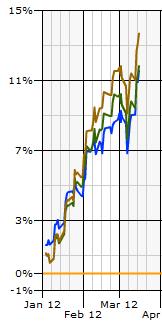
On the Forex side, it has been a rough first quarter. I added it all up, and I'm down about $500 or 2% of my 20K investment. We had some spectacular action in Atipaq Full Portfolio, which at one time in the quarter was up as much as 20%. A recent string of losses has given half of that back and for now is starts up about 9.15% on the quarter. I don't think there's much to read into this other than the fact that some investments go through bad periods when others are doing well. But its clear that my 30% to 60% per year performance goal in Forex is not happening this year. You may have individual accounts that perform that well, but on aggregate, the results are no where near that good.

On the plus side is Sunqu, our only truly adaptive trading system. This system currently has a long EUR/USD position which, if closed would put it into the positive for the year. This one will be interesting to watch.

That's all I have for you. I have been busy at my day job taking on entirely new computing platforms and devices. Its a lot of fun, but also a lot of work. So I don't have much extra time for forex development.

Enjoy your weekend.

Friday, March 23, 2012

Meta-Trader - Top 10 reasons ..

Welcome back Meta-Traders.

It's customary for old-timers like myself to complain about how bad things are. People seem to place a value on negativity since it shows a certain dissatisfaction with the status quo. What can we learn from someone who is happy and satisfied? After all, complacency never got anyone to the top of anything in life, right?

Well I have a slightly different take. Despite vast government dysfunction, record deficits, and new all-time high prices in energy and the cost of a college education, I think things are actually better now for active traders and investors than they have ever been in the history of the world.

With this post I'm going to take you through a David Letterman-style top-10 list of why these are the good old days for active traders and investors. And here we go:

10) The Internet

This one seems like a no-brainer, but the vast majority of the world's knowledge is available in seconds from your PC or hand held device, and most of it for free! The importance of this cannot be understated, and opens a world of self-development for information workers such as myself. Back in the bad old days, we had to read books and magazines, go the library and call companies for them to send information via snail mail. Yes it worked, but progress was much slower.

9) Regulation Fair Disclosure

This law applies to US-Based investors and was enacted back in 2000 and it says that important market-moving information has to be disclosed to everyone at the same time - not just the big boys. Of course the vast majority of market-moving information comes out real time favoring those who pay attention. Not huge but clearly levels the playing field.

8) Decimalization

Back in the bad old days, stocks were traded in fractions, halves, eights, quarters and sixteenths. You needed to be able to calculate your profit on 500 shares purchased at 38 1/8 and sold and 39 9/32'nds. Worse than that, the spreads were also shown in fractions, so a quote would for MSFT would look like bid 38 1/2 ask 38 3/4. On 100 shares, the spread was $25, or 1000 shares, $250. What a mess.

7) Disintermediation

Back in the bad old days, every security had a human making a market in the security and collecting the bid-ask spread all day, every day in exchange for making a market. This is still the case today to some extent, except that multiple market maker's compete to make a market in the same securities on electronic platforms. Add to that the requirement by the US SEC that all market makers must execute at the NBBO (National Best Bid or Offfer). This along with decimalization has killed the livelihoods of an entire generation of market makers to the benefit of the investing public.

6) Discount brokers

Charles Schwab pioneered this category back it the 1980's and broke the hold of the big brokerage firms on the retail brokerage industry by reducing the average trade to the $20 range and below for 100 shares of stock.

5) Exchange Trade Funds

Back in the bad old days, if you wanted to buy the entire S&P 500, you had to go industry leader Vanguard, or another mutual fund giant. Now, I can buy the entire SP-500 or Dow-30 in a single ETF traded with my discount broker and collect the dividends. ETF's SPX, DIA are still among my core, long-term holding in my equity accounts.

4) TC2000

Back in the bad old days, you had to pay for real-time quotes and only 30-minute delayed quotes were available free to the public. Now you can get free real-time quotes from a multitude of web sites including your own discount broker. And with TC2000.com, you can get real-time quotes charting, scanning, etc for under $300 per year.

3) Options

Puts, Calls, Leaps, Strangles, Straddles, you name it. You can benefit from up, down flat or sideways markets. Imagine if you could walk into a retail store and find something that wasn't selling and nobody wanted. And imagine if you could take that item to the counter and sell it to the store and collect the sale price, and then just walk away and wait for that item to expire worthless and collect the entire sale price. That goes on all the time in the Options Market. Consider the possibilities.

2) Deep Discount Brokers

Refer back to #6 and ask yourself, instead of paying $20 or $10 for 100 shares of stock or 1 option contract, imagine if you could pay just $1. That's what deep discount brokers TradeStation and Interactive Brokers do for professional traders. I'm still paying $10 a share with E*Trade, so I'm gearing up to take advantage of this probably next year.

And the #1 reason why these are the good old days for active traders an investors ...

1) Easy money from the Fed

And endless flow of free and easy money from the US Fed and nearly every other major central bank in the free world.

Count your blessings and enjoy your weekend.

Friday, March 16, 2012

Meta-Trader - Going parabolic

Welcome back Meta-Traders.

It was yet another good week in US equities with new all-time highs in AAPL, IBM, and YUM Brands. We also had meaningful breakouts in the financial and the transportation sectors with broad participation which lends some credibility to the broader stock rally.

Apple had another spectacular week, tracing out the full distance between last Friday's close at 545.07 and 600.01 which it tagged briefly on Thursday before closing the week in the mid 580's.

Study the chart on the left carefully to notice the gaps. Of this 55 point range from 545 to 600, we had upside gaps in the morning on 4 out of 5 days. If you add up the entire point movement of those gaps, it adds up to 20 points or nearly 30% of entire movement! This means that day-only traders left about 30% on the table and you had to hold this stock or the options overnight to capture the full movement. This type of action is exceedingly rare, and even more exceptional given that AAPL is now the highest capitalized stock in the US market, exceeding is nearest rival Exxon Mobil by 20%!

Regarding the upside gaps, notice that none of those gaps were filled, except for the Thursday opening gap where the stock opened with an 11+ point opening gap, printed at 600, printed again at 600.01, the fell back. That price action appears to the right of the chart above which is up to the first hour of trading on Thursday morning. Thursday's gap was filled later that day and Friday's action was well within Thursday's range. So this means that AAPL has found a solid value area, at least for the time being.

That said, I will be buying breakouts of the $600 area. One brokerage raised their price target to $720 this past week. Given the price, earnings and product momentum, AAPL could easily reach $1000 per share in the next 12 months. This is a flash back to Qualcomm back in the late 1990's which went from about $4 a share to over $100 per share in about a 13 month period. Take heed and profit fellow traders, these moves don't come along that often.

All this bullishness led my equity portfolio to a 3-year high, taking out the highs of last spring. I'm not that great an equity trader, but its easy to make money with a stock like this. Simply buy when it exceeds the old high, and changes are, you will make money. But watch carefully for topping action, and fortunately APPL is very easy to read where tops are concerned.

One more observation. Due to weekly options, every week is now options expiration week. We tend to see most of the big moves early in the week with flattening and base building on Thursday and Friday and AAPL's price action reflects that perfectly this past week.

Here are some developments on the Forex side:

- All demo accounts have been shut down including Amachay which was down about 10% at that time and a dismal failure in my testing. Additionally, I could not replicate the results on Asirikuy which were somewhat better but not spectacular if I recall.

- Megadroid and FX-Regression accounts have been liquidated with the proceeds moved to Atinalla #3 and Atipaq full portfolio respectively.

- I stopped trading Coatl H1 and closed all open positions. The account was down about 11%, well short of the 49% worst case scenario. My reasoning was that compared to the 1 other Coatl H1 account on Asirikuy, it was not trading properly. Case in point as follows. Coatl opens up positions that sometimes last days and even months.

When comparing my Coatl H1 portfolio to the other one on Asirikuy, the other one had positions still open from January and February. My portfolio - which also traded live since late 2011 - had all of its positions opened in the month of March! So clearly, either the order opening or the order close mechanism has gone awry. How could this happen after I went though all the proper steps in vetting this account for live trading?

After some reflection, the only plausible explanation I can come up with is an upgrade to the experts to move to a new, internally developed library in early 2012. The other systems I'm trading also took that upgrade, and they are trading properly. So in the end, I don't really know what caused the differences in behavior. But is was clear that I did not need to let the portfolio go to its worst case scenario to find out it wasn't working properly. Also, trading is about limiting losses and letting profits run, and I was not willing to take any additional losses in the face of a misbehaving expert system. I would be curious to know of the other Coatl H1 account took the experts upgrade so see if that either confirms or refutes my hypothesis.

That's all for now, enjoy your weekend and the fruits of your labors.

Friday, March 9, 2012

Meta-Trader - Breakfast in America

Welcome back Meta-Traders.

Spring has sprung in North America, and things are looking up. We had some positive developments this past week, most importantly a pending deal for resolution of holders of debt issued by Greece. Another positive was a jobs bill passed my the US Congress in a bi-partisan manner by our elected representatives and supported by our President. Nice to see some harmony and consensus from Capitol hill for a change.

My Forex portfolio edged back to the positive this week, even if just slightly. I'll get to the specifics below, but first a word or 2 about my favorite stock Apple Computer.

Its easy to dismiss Apple as a fad, but stay with me for a moment here. If we look back 60 days to 1/9/2012, Apple stock was priced at $421 per share. Today, a mere 60 days later, the stock is priced at $545 per share. With 900M shares outstanding, that move represents a gain in market capitalization of about 111 billion dollars! That represents a real creation of value that can be spent on cars, houses, employees and all the things that make our economy work. And that's a great thing about the stock market is that it creates wealth where there was none before. Of course, it could all evaporate in a short time, but we have the wind at our back in the form of an incredibly accommodating US Federal Reserve.

The chart above shows a 5 days of history of the March Apple 550 put contract on an hourly basis. I traded this contract briefly this week a made a point or 2, but take a look at the range. The contract had a high on the week of 35 and a low of about 9.5. That represents a 300% change from top to bottom! In dollar terms that means a low of $950 and a high of $3500 with about half the value being traced out in a single day's trading. I don't know of any financial instrument that provides this amount of movement on a pure cash basis, in other words without use of margin.

Also regarding equities, we had new, all-time highs in portfolio holdings IBM, SXCI and Yum Brands. Generally speaking though, I expect some upcoming bearish action in equities and most charts gapped down on Tuesday and ran back up to the top of the range on Friday without taking out the prior high. I will be watching the AAPL Puts closely, as I think there's some money to be made there.

Forex has not gotten much love lately and I am glad to say we finally have something good to report. We had new equity highs this past week in Atipaq Full Portfolio and Atinalla #3 both of which ran out to new highs before pulling back. Offsetting those gains is Coatl H1 which continues to bleed money and is down a nasty -11.06% for the year. Taking a look at Asirikuy, my account is behaving much differently than the one other instance of Coatl H1 on Asirikuy, and that has me concerned.

All told, my forex accounts are up about $200 for the year which represents just 1% of my 20K invested. But this a paltry return compare to equities where I am up 9% and 11% respectively in my retirement and cash accounts.

In terms of upcoming Forex changes, I am going to transfer the funds in my Megadroid and FX-Regression accounts over to Atipaq Full Portfolio and Atinalla #3. Since those 2 accounts are basically idle, this will make better use of the funds. Its significant, through since I've finally thrown in the towel on Megadroid, a system which once believe held a lot of promise. But times change and we keep doing what works, and throw out what does not.

As for the rest of the weekend, its time to turn my attention to taxes. Reconciling all of my buying a selling is a painful and cumbersome process and ranks up there with cleaning bathrooms and going to the dentist. Its not pretty but it needs to be done.

Enjoy your weekend.

Saturday, March 3, 2012

Meta-Trader - New High, Low PE, High Growth

Welcome Back Meta-Traders.

While this blog is supposed to be about Forex, I have had much more success lately with stocks and options. In this post I’m going to talk about how I go about the process of trading options on stocks. In some recent trades, I have found that I can risk about as much capital as I have in any of my Forex accounts, and make 30% to 50% in a just a day or two! We can’t be sure how long this is going to last, but it has been working recently so that makes it relevant.

Start by deciding which stock to trade out of the 5,888 stocks available to US-based investors.

To approach this, I use the TeleChart 2000 charting package at http://www.tc2000.com. This program is 100% browser based and uses Microsoft’s Silverlight technology. TeleChart 2000 is a marvelous charting and organizational tool. Once of its great features is real-time market scanning and filtering. All this including real-time streaming intra-day charts, all for about $300 a year, amazing! It even includes Forex, so check it out.

Here is the scan I use:
  • New 10,000 day highs - that is equal to a 40 year-look back period so that’s essentially a new all time high. I always pay attention when a stock makes a new all-time high since it’s the most bulling thing a stock can do.
  • PE (Price to Earnings Ratio) less than 20. This one will filter out stocks which have high valuation (or more importantly) stocks with zero or negative earnings. We want stocks with positive earnings since we want every possible advantage in our favor.
  • 5-year earnings growth rate greater than zero. Again this filters out stocks without positive 5-year earnings history but there’s more to it and I’ll get to that in a second.
This scan can reduce over 5,800 stocks to just a handful of issues in less than one second! The scan shown on the left came back with 26 symbols, a very manageable number to handle.

Next, scroll over and take a look at the columns displayed. I have my columns setup as follows: Symbol, Price, Net Change, Net % change, Day High, Day Low, 5-Year Earnings Growth, PE, and Dividend Yield.

Now pay particular attention to the 5-Year Earnings Growth and PE. Jim Cramer says for a growth stock you can pay for a PE up to 2 times the growth rate. So for a stock with a 5-year earnings growth rate of 10% you can pay to 20 for a PE. As it turns out, there are plenty of good stocks whole growth rate whose growth rate is actually higher than the PE! This means that the stock is undervalued and could conceivably double in price.

Next ask yourself how is the market behaving today? The number of stocks returned in the scan alone is somewhat of an indication. If the market is behaving poorly or going down, don’t take any long positions. If the market is behaving well, go in favor the trend and buy breakouts. Always go with the trend of the market – don’t fight the tape!

Load up your Market data screen with all of your portfolio symbols and your favorites from the scan and watch, particularly the first 30 minutes of the trading day. I hardly ever trade in the first 15 minutes of the trading day since opening gaps are typically quickly reversed. In fact many pros make money scalping against the opening gap as we saw with Hubert Senters last week.

From this point, picking what to trade and when is completely subjective and takes experience and intuition. Check for news and earnings before taking a trade. I try to avoid stocks where there is any meaningful news or news pending. For example, if the stock just reported earnings yesterday, and has a big gap up, avoid it. Similarly, if the stock is running hard and earnings are due out after the close, avoid it as well unless you have a read on the earnings which I rarely do -except in the case of Apple recently. Ideally you want to see a stock that’s moving slowly but steadily, and earnings are due out in a week or two. Sometimes the nicest looking charts are the ones running up into earnings, just to get slammed the next day when the news comes up. I traded for years that way, getting blind-sided by earnings reports, tread carefully!

Also, the market depth screen sometimes helps to gauge supply and demand for a stock, but most participants don’t show their complete hand, so you have to paint a bigger picture in your mind based on the price action.

It occurred to me last weekend to trade high-priced stocks only. Those are the ones inclined to make big moves 5 or more points a day. Once you have your symbol and everything is right, go to the options chain. Whether you are bullish or bearish, pick the least expensive in-the-money option contract with at most a point or 2 premium so that you get a 1 for 1 move as the stock moves up. In options parlance, you want options with a delta close to 1 meaning the price of the option will go up 1 point for each 1 point rise in the underlying.

Using this method, I had 3 successful trades this past week in AAPL (Apple Computer), MA (MasterCard) and ISRG (Intuitive Surgical) and took in a total of 18 points of profit. The prior week, I took 3 trades and lost on all 3 trades, and lost a total of about 5 points.

All that said; let’s not confuse brains with a bull market. This market has gone straight up from the start of 2012. I make most of my money in bull markets, since I play mostly the bull side. There’s no telling when it ends, but we will stay with it as long as it lasts.

Have a great weekend all.

Sunday, February 26, 2012

Meta-Trader - Meet Hubert Senters

Welcome Back Meta-Traders.

This past week I had the opportunity to attend the Traders Expo in New York City. I find these events tremendously helpful since I get to see face-to-face some of my favorite market personalities and gain valuable insights as to how they approach their craft. If you have not been to one of these shows, I highly recommend it. You can find the organization at http://www.moneyshow.com and they do 12 shows a year all around the globe. Admission is free and while there is plenty of stuff for sale, you can take as much information and learn as much as you can for free in exchange for your contact information.

I don’t know about you, but I labor in obscurity most of the time. I do my day regular job, and take care of business, both home and family. But underlying all that, there’s a part of me that wants to spend all day, every day with people who make their living in the markets. I try to talk about it with my family, but most of the time, they give me a blank stare and change the subject. These shows give you a chance to hear presentations from those who have made it big and how they did it so you can associate with those people - even if just for one day.


So with this post I’m going to start a new “Meet the Trader” series. In each post, I will cover one trader or personality that I particularly enjoy and what I learned from them.

In this post, we meet Hubert Senters from http://www.tradethemarkets.com. Hubert partners with John Carter and others to run the Web site which is an advisory and trading community focused around Futures, Stocks and Options and Forex to a lesser degree. I got to see a presentation by Mr Senters after knowing him for some time through the free daily trading videos you can get from their website. He also hosted a 2+ hour live trading Webcast last year on the Friday after Thanksgiving when opened his trading room to the public via conference call and live meeting. That said, I’m not a customer of their site nor have I spent any money with them.

Anyway, Hubert is a kindly southern gentleman with a disarming personality and a keen sense of humor. He trades Futures only. At the expo one person kept asking him, why not Stocks or Options? He replied he just doesn’t like them and when pressed, he mentioned the favorable tax treatment we get from Future profits in the United States versus stocks. There’s another better reason that I’ll get to below.

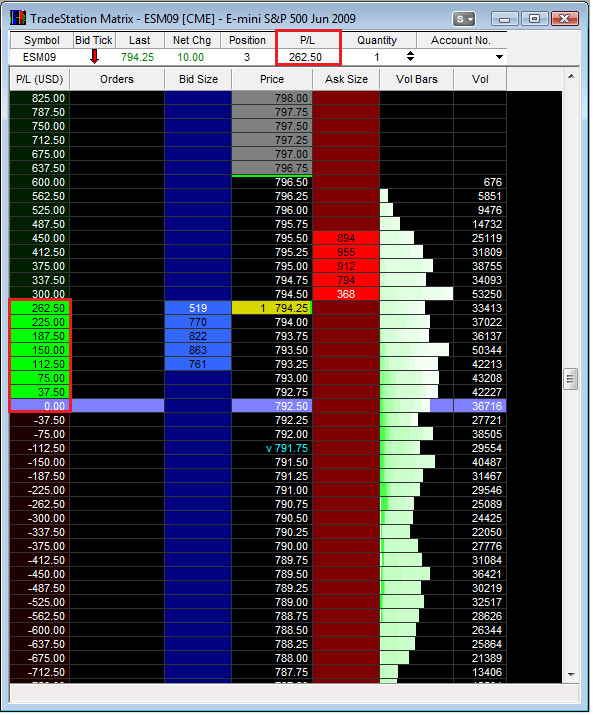
Hubert is a self-made man and trades his own account, full-time from the basement of his house. He describes it as the “Bat Cave”, an 1100 square foot space with high security – visitors have to be “buzzed in” from the outside. As for trading platform, he runs Tradestation on Dell Desktops with an array of flat panel displays. He has a device called a TreadDesk where he can walk in place when trading and move the desk up and down as needed. How’s that for a cool way to incorporate our hunter/gatherer roots with a modern way to make a living?

I mention his trading setup because like me he is a bit of a loner and was clearly not comfortable speaking in front of a large group – at first anyway. He was also uncomfortable in a suit and indicates he spends a lot of time trading in just boxer shorts, and sometime goes days without showering – something I can relate to since I work at home a lot – though I usually just skip a day or 2.

As for trading style Hubert is mainly a day trader, but sometimes position trades as well. Here are 3 specific setups (among many) he uses to pull out profits from the markets on a daily basis:

• Scalp against the Opening Gap. Hubert indicates that opening gaps in the futures market will close a high percentage of the time. I saw him do this trade the day after Thanksgiving and he made a few hundred dollars in the first few seconds of the trading day. And he was using reduced lot sizes for the presentation.

• Another trade is to go long or short the futures when daily program trading levels are breached as measured by Cash to Futures Premium as found on http://www.indexarb.com. Hubert prefers the Dow or Russell Futures versus the E-Mini S&P which he calls a “sprinter” meaning it runs up and runs back and is much more whippy and volatile. He makes the analogy – why try to land a crop-duster on a moving aircraft carrier when you can land it in an open field?

• One last trade is more of a position trade and he calls it the “Goodnight Gold” trade. He says he made more money with this strategy than any other in the past 2 years and it goes as follows. Trade the full-size Comex Gold Contract which follows the price of Gold up and down at $1785 per ounce and can easily move $25 in one day. Take the price at 11:30 PM and subtract from the price earlier in the day at 1:30 PM. If the price is more than $3 up or down (but not too far up or down) take a trade in the direction the move. Use a 6 point stop and a 60 point take profit. If the trade loses, you lose $600. If the trade wins you make $6000. This trade can last several days and he sometimes takes profits on the way to 60 points at 18-20 point intervals. Note that with this type of Risk to Reward ratio, the system will lose far more often than it wins.

Hubert makes a lot of money. He has been profitable pretty much since day one and learned to trade from a guy he ran into by accident when he was working as apprentice to be a large animal vet. When he saw the market data screen, and saw the guy had made $150,000 that day, he was instantly hooked. He became the trader’s apprentice and learned from the guy for 18 months before going out on his own. Hubert’s parents worked in a factory, and he could easily make in one day what they make in a year.

Hubert started out with a $5000 trading stake that he pulled together between his wife and some family loans. He turned that into $20,000 in one day, before giving much of that back and ending the day with $11,000. He grew the initial $5000 into 1.8 Million within about 18 months. He tells a funny story about how making all that money messes with your head and makes you buy stuff, houses, cars etc – but remember to put money aside to pay the tax man!

Hubert acknowledges that only a small percentage of futures traders are successful and that the odds are clearly stacked against you. I think the thing I learned most from Hubert is that you don’t need nearly as much capital as I thought to make a living trading. The extra leverage provided by futures forces strict risk management. Someone once remarked that trading stocks is like driving to California, while trading futures is like taking an airplane!

Check out Hubert and John at http://www.tradethemarkets.com and have a great week.